
Knee Ligament Injuries Missoula, MT
Specialties
Missoula Orthopedic Knee Specialists Providing Knee Ligament Injury Care Throughout Montana
Patients across Montana trust the experienced orthopedic knee specialists at Northern Rockies Orthopaedics to provide comprehensive care for all types of knee ligament injuries. Knee injuries can happen to anyone, from athletes playing hockey or football to people who simply twist their knee getting out of a car. These injuries affect your ability to walk, work, and enjoy the outdoor activities that make Montana special. We treat patients of all ages and activity levels, creating personalized treatment plans that address everything from minor sprains to complete tears requiring surgery.
Schedule an appointment with our orthopedic knee surgeons in Missoula, Montana, by calling our office at (406) 728-6101 or visiting our contact page to discuss your treatment options.
What Are the Ligaments in the Knee?
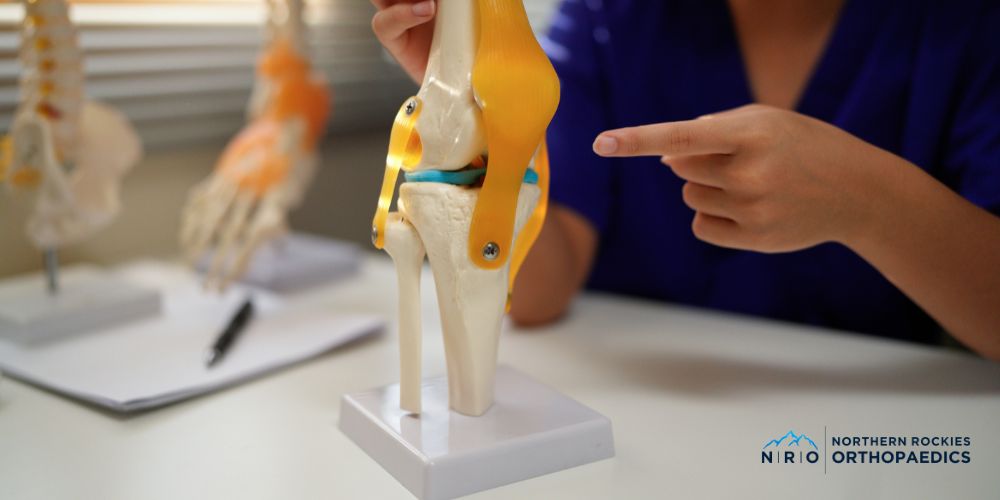
Ligaments are bands of flexible connective tissue that connect bones to other bones and provide stability to the knee joint. These elastic tissues act like strong cables that hold the knee together while still allowing controlled movement.
When ligament damage occurs, patients often experience pain, swelling, and a feeling that their knee might give out or buckle during normal activities. There are four major ligaments in the knee, divided into two groups: the cruciate ligaments, located inside the joint, and the collateral ligaments, positioned on the sides of the knee.
Cruciate Ligaments in the Knee
The cruciate ligaments sit inside the knee joint and cross each other to form an “X” shape that controls forward and backward movement. The anterior cruciate ligament (ACL) prevents the shin bone from sliding too far forward and controls rotation and forward movement of the knee.
The posterior cruciate ligament (PCL) controls backward movement by keeping the shin bone from sliding too far back under the thigh bone. These internal tissues work together to maintain knee stability during activities that involve sudden stops, directional changes, or jumping.
Collateral Ligaments and Their Function
The collateral ligaments run along the sides of the knee and provide side-to-side stability to prevent excessive lateral movement. The medial collateral ligament (MCL) protects the inner knee from forces that push it outward, while the lateral collateral ligament (LCL) protects the outer knee from forces that push it inward.
These ligaments of the knee keep the joint stable when you plant your feet and change direction or absorb impact from the side. Collateral ligament injuries commonly occur when the knee receives a direct blow from the outside or inside, such as during a football tackle or when the leg buckles inward.
Common Types of Knee Ligament Injuries in Missoula
Knee conditions in Missoula, Montana, like ligament injuries, frequently result from sports injuries, outdoor recreation activities, sudden falls, and work-related accidents. Athletes playing contact sports face a higher risk due to the sudden twisting motions, abrupt stops, and collisions inherent to their activities.
Skiers, hikers, and other outdoor enthusiasts in Montana’s terrain often sustain these injuries when their feet stay planted while their bodies rotate or when they land awkwardly from a jump. Even everyday activities like stepping off a curb wrong or slipping on ice can cause a torn ligament if the forces exceed what the elastic tissue can withstand.
ACL Injuries and ACL Tears
ACL injuries are the most common ligament injuries in the knee, particularly among athletes who play cutting and pivoting sports such as football and basketball. The anterior cruciate ligament typically tears when athletes make sudden stops, change direction rapidly while running, jump incorrectly, land with their knees turned inward, or receive direct impact to the knee.
Patients with ACL tears often report hearing or feeling a popping sound at the moment of injury, followed immediately by severe pain and rapid swelling. The knee feels unstable, and many people describe the sensation that their leg buckles when they try to put weight on it.
Other Cruciate Ligament Injuries
A cruciate ligament injury may involve the PCL alone or occur in combination with other knee ligaments. PCL injuries typically result from direct impact to the front of a bent knee, such as hitting the dashboard in a car accident or falling hard onto a flexed knee.
Combined cruciate injuries that damage both the ACL and PCL create severe instability and usually require surgical intervention. These injuries are less common than isolated ACL tears but tend to be more serious because they compromise multiple structures that control knee movement.
Collateral Ligament Injuries
An MCL injury occurs when force pushes the knee inward, stretching or tearing the ligament on the inner knee, often from a blow to the outer side of the knee. LCL injuries are less common but result from forces that push the knee outward, damaging the ligament on the outside of the knee.
These collateral ligament injuries range from mild stretching (sprains) to partial tears to complete ruptures that destabilize the entire joint. Accurate diagnosis and appropriate treatment prevent long-term joint instability that can lead to chronic pain and increased risk of additional knee injuries.
Knee Ligament Injury Symptoms
Pain, swelling, and stiffness develop rapidly after a knee injury, typically within hours as internal tissues respond to the trauma at the injury site. Patients notice a feeling of instability or a sense that their knee might give out during weight-bearing activities like walking or climbing stairs.
Many people hear a popping sound at the moment of injury and experience severe pain immediately afterward. Limited range of motion makes it difficult to fully straighten or bend the knee, and some patients cannot bear weight on the affected leg without significant discomfort.
How Are Knee Ligament Injuries Diagnosed?
Our knee specialists begin by reviewing your health history and asking detailed questions about how the injury occurred and what symptoms you’re experiencing. During the physical examination, we perform specific tests to check joint stability, assess which ligaments may be injured, and evaluate your range of motion.
We may apply gentle stress to the knee in different directions to determine which surrounding ligaments remain intact and which have sustained damage. Imaging tests such as X-rays help rule out fractures, while an MRI provides detailed views of the ligaments and other soft tissues to confirm the diagnosis and determine whether you have a partial tear or a complete tear.
How Are Knee Ligament Injuries Treated at Northern Rockies Orthopaedics?
We create personalized treatment plans based on the severity of your ligament injury, your activity level, your age, and your goals for recovery. Our comprehensive approach combines non-surgical treatments like bracing and physical therapy with advanced surgical techniques when necessary to restore stability, strength, and function.
We focus on getting you back to the activities you love while minimizing your risk of reinjury. Our knee treatments in Missoula, Montana, address all types of knee ligament injuries treated at our practice, from minor sprains to complex multi-ligament reconstructions.
Non-Surgical Treatment Options
A knee brace provides external support to protect the injured ligament while it heals, proving especially effective for partial MCL and LCL tears. Physical therapy programs include muscle-strengthening exercises that build up the muscles around the knee, restore range of motion, and prepare you for a return to normal activities.
We provide guidance on activity modification to protect the ligament from additional stress during recovery while maintaining your fitness level. Platelet-rich plasma (PRP) therapy uses concentrated platelets from your own blood to potentially enhance healing at the injury site, and some patients with partial tears benefit from PRP injections combined with other conservative treatments.
Surgical Treatment for Knee Ligament Injuries
Surgery becomes necessary when conservative treatments fail to restore adequate stability or when the severity of the tear makes healing unlikely without intervention. Our orthopedic surgeons use advanced techniques to repair or reconstruct damaged ligaments and return patients to their desired activity level. The specific surgical approach depends on which ligament is injured, whether the tear is partial or complete, and the overall condition of the knee joint.
Knee Ligament Repair Surgery
The surgeon reattaches the patient’s original ligament to the bone with sutures when the tissue quality remains good, and the tear occurred near the attachment point. This approach works best for acute collateral ligament injuries, particularly MCL tears, where the ligament pulls away from the bone but the tissue itself remains healthy. Ligament repair preserves your natural elastic tissue and typically involves a shorter recovery compared to reconstruction surgery.
Knee Ligament Reconstruction Surgery
Reconstruction replaces the torn ligament with a graft taken either from another part of your body or from donor tissue when the original ligament has been severely damaged. Surgeons most commonly use this technique for ACL tears and complete cruciate ligament injuries where the tissue has frayed or retracted too far to repair.
The graft serves as a scaffold for new tissue to grow on, eventually restoring stability and allowing a return to high-level activities. Most ACL reconstructions require this approach because the anterior cruciate ligament has a limited blood supply and rarely heals on its own.
Recovery and Rehabilitation After a Knee Injury
Physical therapy plays a critical role in recovery by strengthening the muscles around your knee, improving balance and coordination, and gradually increasing your activity level. Your therapist designs a progressive program that moves you through different phases of healing, from initial pain and swelling management to sport-specific training. Patients who commit to their rehabilitation program and follow activity restrictions typically achieve better outcomes and return to their previous level of function more successfully than those who rush the process.
Knee Ligament Injury FAQs
How do I know if I tore a ligament in my knee?
Signs of a torn ligament include immediate pain and swelling after injury, a popping sound at the time of injury, knee instability or the feeling that your leg buckles, and difficulty bearing weight. An accurate diagnosis requires a physical exam and imaging tests by a knee surgeon or sports medicine specialist.
Can you walk with a torn ligament in your knee?
Some people can walk with certain torn ligaments, particularly partial MCL tears, though they may experience pain and instability. However, complete tears of the ACL or multiple ligaments often make walking difficult or impossible without the knee giving out, and attempting to walk on a severely injured knee can cause additional damage.
How to test for knee ligament injury?
Our specialists perform specific physical examination tests that apply gentle stress to each ligament while monitoring how the knee responds. We combine these manual tests with your description of how the injury occurred and imaging studies to determine which ligaments sustained damage and how severe the tear is.
Are cruciate injuries the same as ACL injuries?
Not all cruciate injuries are ACL injuries. The term “cruciate injury” includes both anterior cruciate ligament injuries and posterior cruciate ligament injuries. While ACL tears are more common, PCL injuries also qualify as cruciate ligament injuries because the PCL is one of the two cruciate ligaments inside the knee joint.
How long does it take to recover from a knee ligament injury?
Recovery time varies widely depending on which ligament is injured and the treatment approach: minor MCL sprains may heal in 2-4 weeks with rest and bracing, while ACL reconstruction typically requires 6-9 months before return to sports. Your specific recovery timeline depends on factors including injury severity, surgical technique if needed, and how diligently you follow your rehabilitation program.
Get Expert Knee Injury Care at Northern Rockies Orthopaedics in Missoula, MT

Northern Rockies Orthopaedics provides comprehensive care for all types of knee ligament injuries, from conservative treatment of minor sprains to advanced surgical reconstruction. Our knee surgeons understand how these injuries impact your life and work with you to develop a treatment plan that gets you back to the activities that matter most. From athletes looking to return to competition to individuals who simply want to walk without pain, we have the skills to help you achieve your goals.
Contact our office by phone at (406) 728-6101 or through our online contact page to schedule an appointment and start your recovery today.
Patient Testimonials
Move Better. Feel Better. Perform Better.
We are committed to high quality orthopedic healthcare and implementing innovative, value-added solutions to deliver compassionate, patient-centered healthcare.