
Wrist Arthroscopy in Missoula, Montana
Specialties
Advanced Arthroscopic Wrist Surgery in Missoula, Montana

Wrist arthroscopy in Missoula, Montana is a minimally invasive solution for patients whose wrist pain makes even the simplest daily tasks feel impossible, from opening a jar to typing at a keyboard. Early diagnosis and treatment of a wrist injury can prevent further damage to the joint and preserve long-term function. The hand and wrist surgeons in Missoula, Montana, at Northern Rockies Orthopaedics use the latest arthroscopic techniques to help patients in Missoula and surrounding communities get back to the activities they love.
If you are experiencing wrist pain, weakness, or numbness, contact our office at (406) 728-6101 or use our online form to request an evaluation.
What Is Wrist Arthroscopy?
Wrist arthroscopy is a minimally invasive surgical procedure in which a surgeon uses a narrow fiber optic tube with a small camera fixed to its end to examine and treat the interior of the wrist joint. The surgeon inserts the tiny camera through small incisions in the skin, projecting detailed images onto a video monitor in the operating room.
Unlike traditional open surgery, which requires a larger incision to access the joint, arthroscopy allows the surgeon to diagnose and treat wrist disorders with far less disruption to surrounding tissue. Surgeons use this technique to identify damage to bones, ligaments, tendons, and cartilage during the same procedure, reducing the need for additional surgeries.
Conditions Treated With Arthroscopic Wrist Surgery

The wrist is a complex joint made up of eight small bones, along with a network of connecting ligaments, tendons, and blood vessels that work together to support motion and stability. Arthroscopic wrist surgery addresses a broad range of hand and wrist conditions in Missoula, Montana, from traumatic injuries and degenerative arthritis to nerve compression issues and soft tissue problems.
Surgeons typically recommend arthroscopy when conservative treatments such as bracing, physical therapy, or injections have failed to relieve wrist pain or restore function. To explore the full scope of wrist and hand treatments in Missoula, Montana, available at Northern Rockies Orthopaedics, patients can speak with a member of our surgical team.
Ligament Tears in the Wrist Joint
Ligament tears in the wrist joint commonly result from sports injuries, falls onto an outstretched hand, or repetitive strain over time. Patients often report instability, persistent wrist pain, and weakness that makes gripping or rotating the wrist difficult.
Left untreated, torn ligaments can lead to progressive joint damage and long-term instability, making early repair essential. During arthroscopic wrist surgery, the surgeon repairs or reconstructs the damaged ligaments through small incisions, restoring stability to the wrist with less pain and a shorter recovery than open surgery would require.
Triangular Fibrocartilage Complex (TFCC) Injuries
The triangular fibrocartilage complex, or TFCC, is a structure of cartilage and ligaments on the pinky side of the wrist that stabilizes the joint during rotation and gripping. TFCC injuries often occur after a fall, a twisting motion, or repetitive loading of the wrist, and patients typically experience pain on the ulnar side of the wrist along with clicking or weakness.
The dorsal sensory branch of the ulnar nerve and the superficial sensory branch of the radial nerve run near this region, so surgeons take care to protect these structures during the procedure. Arthroscopic techniques allow surgeons to repair or trim the damaged triangular fibrocartilage with precision, relieving pain and restoring wrist stability through small cuts rather than a larger incision.
Wrist Arthritis
Wrist arthritis develops when protective cartilage within the wrist joint breaks down due to wear and tear, prior wrist injury, or underlying medical conditions. Patients experience stiffness, swelling, reduced range of motion, and wrist pain that worsens with activity.
Arthroscopic surgery allows the surgeon to remove inflamed tissue, smooth damaged cartilage, and reduce swelling within the joint using a small camera and specialized instruments. Patients dealing with hand and wrist arthritis in Missoula, Montana, can discuss all available surgical and non-surgical options with the team at Northern Rockies Orthopaedics.
Wrist Fractures
Wrist fractures can affect the distal radius and the surrounding wrist bones, sometimes causing undetected damage to the cartilage and connecting ligaments of the joint. Surgeons use wrist arthroscopy alongside fracture repair to evaluate the interior of the joint for ligament tears or cartilage injury that magnetic resonance imaging may not fully capture.
The small camera allows the surgeon to assess the joint at specific locations and address any soft tissue damage during the same procedure. This minimally invasive wrist surgery approach supports more thorough treatment and can improve long-term outcomes compared to fracture repair alone.
Ganglion Cysts
Ganglion cysts are fluid-filled sacs that form along the tendons or joints of the wrist and are among the most common wrist conditions treated at Northern Rockies Orthopaedics. Patients may notice a visible lump on the wrist along with pain, tenderness, or limited motion, and many seek treatment for both cosmetic and functional reasons.
If a ganglion cyst does not resolve on its own or with conservative care, the surgeon makes small incisions to remove the cyst arthroscopically, reducing the risk of recurrence compared to traditional open surgery. Arthroscopic cyst removal also results in less pain, a smaller scar, and a faster return to daily activities.
Carpal Tunnel Syndrome
Carpal tunnel syndrome occurs when the median nerve becomes compressed as it passes through the narrow carpal tunnel at the base of the wrist, causing numbness, tingling, and weakness in the hand. Patients often try conservative treatments such as splinting, activity modification, and corticosteroid injections before turning to surgery.
When those measures fail to provide lasting relief, the surgeon performs a surgical procedure to release the pressure on the median nerve within the carpal tunnel. Arthroscopic surgery accomplishes this release through small incisions rather than a larger incision, offering patients less pain and a quicker recovery.
When Is Wrist Arthroscopy Recommended?
Our hand and wrist surgeons in Missoula, Montana recommend wrist arthroscopy when patients experience persistent wrist pain that does not improve with rest, bracing, or other non-surgical treatments. Instability, mechanical symptoms such as clicking or catching within the joint, and imaging findings that suggest structural damage also indicate the need for arthroscopic evaluation.
Wrist arthroscopy allows the surgeon to both diagnose and treat the source of a wrist injury in a single procedure, sparing patients the need for exploratory open surgery. The goal of arthroscopic surgery is to improve wrist function, relieve pain, and prevent further injury to the joint.
Understanding The Arthroscopic Wrist Surgery Procedure at Northern Rockies Orthopaedics
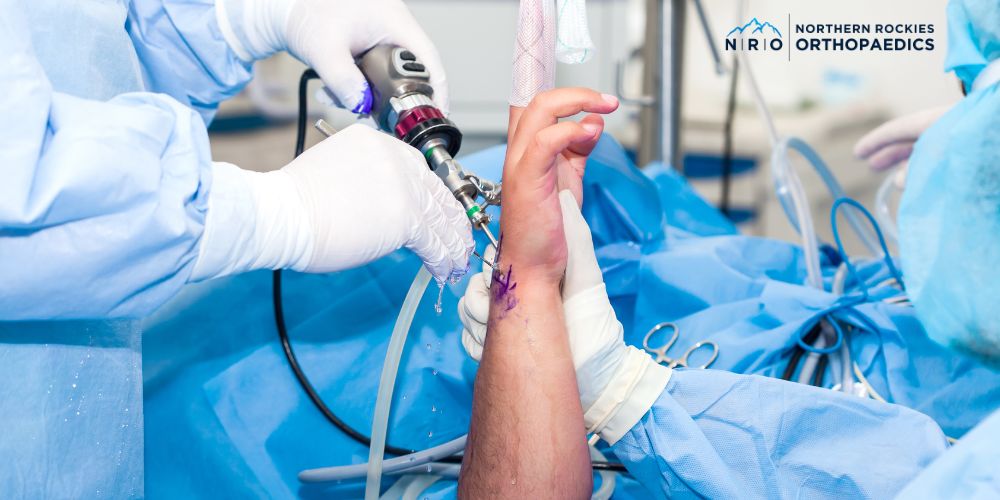
Before surgery, the care team conducts a thorough pre-surgical evaluation that includes a review of magnetic resonance imaging and other diagnostic studies to plan the procedure. Patients typically receive regional anesthesia, and the surgeon uses a traction device to gently separate the wrist bones and create space to maneuver the arthroscope within the joint.
The surgeon makes small cuts at specific locations around the wrist, inserting the narrow fiber optic tube and small camera to transmit live images to the video monitor in the operating room. Depending on the wrist condition, the surgeon repairs, trims, or removes damaged tissue during the same procedure, and most patients go home the same day.
Arthroscopic Wrist Surgery Recovery
After surgery, the care team wraps the wrist in a bandage and may apply a splint to support the joint and prevent excessive swelling during the initial healing period. Patients receive instructions on how to keep the bandage clean and dry, manage pain with prescribed medications, and use blood thinners if indicated to reduce the risk of blood clots.
Post-operative rehabilitation typically begins within a few weeks and includes targeted exercises to restore strength, motion, and stability in the wrist joint. Most patients gradually return to work, recreational activities, and Montana’s outdoor pursuits as the wrist heals, with the long-term outlook for wrist joint function remaining strong when patients follow through with their rehabilitation program.
Request an Appointment With The Missoula Hand and Wrist Surgeons at Northern Rockies Orthopaedics Today

Timely treatment of a wrist injury or wrist disorder can make a significant difference in how fully a patient recovers, and delaying care often allows conditions to progress and become harder to treat. Northern Rockies Orthopaedics offers a full range of orthopaedic services to help patients find the right care path, from conservative management to advanced arthroscopic surgery. Do not ignore wrist pain, numbness, or nerve symptoms, as these signs often point to treatable conditions that respond well to early intervention.
Contact our office at (406) 728-6101 or use our online form to schedule an evaluation and take the first step toward restoring the strength, motion, and comfort you deserve.
Patient Testimonials
Move Better. Feel Better. Perform Better.
We are committed to high quality orthopedic healthcare and implementing innovative, value-added solutions to deliver compassionate, patient-centered healthcare.